According to industry research and market reports, global production of expanded polystyrene (EPS) is currently estimated at approximately 10–13 million metric tons per year. EPS is widely used in packaging, insulation, and food service applications due to its lightweight structure, excellent thermal insulation, and cushioning performance. Although commonly referred to as “Styrofoam” in everyday language, this term is technically a brand name, while EPS represents the broader category of expanded polystyrene foam materials. Despite its widespread use, EPS has long been misunderstood as non-recyclable, leading to improper disposal and unnecessary landfill accumulation.
EPS foam is highly visible in waste streams because of its large volume, even though it accounts for a relatively small percentage of total plastic waste by weight. Its low density creates logistical challenges in collection, storage, and transportation, which has historically limited recycling efficiency. However, with increasing environmental awareness and improvements in recycling infrastructure, EPS recycling rates are gradually rising, particularly in commercial and industrial sectors where large quantities of foam waste are generated.
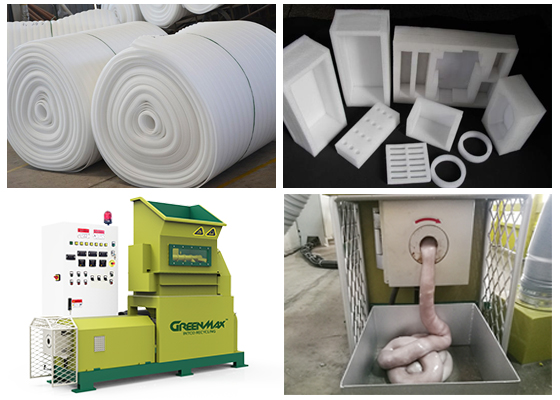
A key solution for managing EPS waste is the use of foam densifiers. These machines significantly reduce the volume of EPS—often by up to 90:1—through processes that involve shredding, compressing, and in some cases thermally melting the material into dense, compact blocks. The resulting densified EPS is easier to handle, store, and transport, which helps lower overall logistics costs and improves the economic feasibility of recycling operations.
GREENMAX specializes in EPS recycling machine, including foam densifiers designed for industrial-scale applications. GREENMAX EPS densifiers are engineered to process large volumes of foam waste efficiently, converting loose and bulky EPS into high-density ingots. In addition to equipment solutions, densified EPS ingots can be integrated into broader recycling supply chains. Some recycling programs and partners offer buy-back services for densified EPS ingots, purchasing compacted material from generators or recyclers. This model helps businesses offset equipment costs, improve return on investment, and create a more circular flow of materials within the EPS recycling ecosystem.
Once densified, EPS ingots are transported to recycling facilities where they are further processed into reusable polystyrene resin through grinding, melting, and pelletizing. The recycled material can then be used in manufacturing applications such as picture frames, construction materials, insulation products, and molded plastic goods. In this way, EPS foam is transformed from a persistent waste stream into a valuable resource that supports both environmental sustainability and economic efficiency.