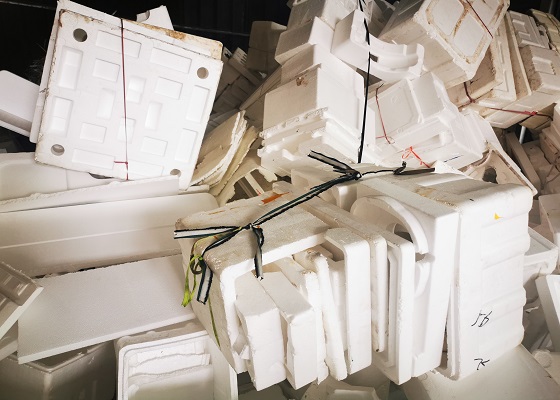
As global awareness of environmental protection continues to grow, businesses are actively seeking more effective ways to recycle waste plastics. Expanded polystyrene (EPS), commonly known as Styrofoam, is widely used in packaging, food service, construction, and cold-chain logistics because it is lightweight and provides excellent insulation. However, its bulky size makes collection, storage, and transportation challenging, creating obstacles for efficient recycling. As a result, investing in a Styrofoam compactor has become one of the most practical solutions for companies that generate large volumes of EPS waste.
Innovative recycling technologies continue to emerge around the world. For example, some companies are developing advanced chemical recycling methods capable of processing mixed or difficult-to-recycle plastics. While these technologies show great potential, they are often designed for specialized applications and require significant investment. For most businesses that generate clean post-industrial or post-commercial EPS waste, mechanical Styrofoam recycling remains the most mature, cost-effective, and commercially proven recycling method.
One of the biggest challenges in Styrofoam recycling is not the material itself, but its low density. EPS is approximately 98% air, meaning a large amount of warehouse space is required to store even a small amount of material by weight. Transporting loose Styrofoam is also expensive because trucks reach their volume limit long before their weight capacity. A Styrofoam compactor addresses this issue by compressing bulky foam into dense blocks, significantly reducing storage and logistics costs while making the material suitable for downstream recycling.
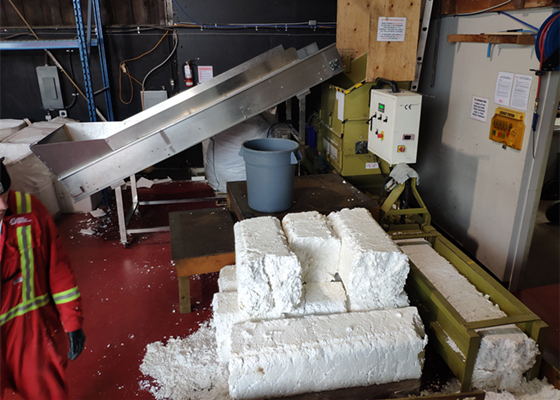
Using a Styrofoam compactor is simple and efficient. After connecting the machine to a power source, waste EPS packaging is fed into the compactor, where it is crushed and cold-compressed into dense blocks without requiring additional chemicals or additives. With a compression ratio of up to 50:1, the machine dramatically reduces foam volume while maintaining material quality, making it one of the most economical solutions for recycling Styrofoam packaging.
After compaction, the recycled Styrofoam blocks become valuable secondary raw materials. They can be transported efficiently to recycling facilities, where they are shredded, pelletized, and transformed into recycled polystyrene pellets. These recycled materials are then used to manufacture a wide range of new plastic products, including picture frames, decorative moldings, skirting boards, and other durable plastic applications, supporting the development of a circular economy.

As a professional foam recycling solution provider, INTCO Recycling GREENMAX offers more than just Styrofoam compactor. The company also provides a complete Styrofoam recycling solution, including equipment selection, technical support, and buy-back services for compacted EPS blocks. By converting waste Styrofoam into valuable recyclable resources, GREENMAX helps businesses reduce disposal costs, improve operational efficiency, and achieve their sustainability goals.
FAQ
1. Why is a Styrofoam compactor used for EPS recycling?
A Styrofoam compactor reduces the volume of loose EPS foam by up to 50:1, making it easier and more economical to store, transport, and recycle.
2. What happens to Styrofoam after it is compacted?
Compacted Styrofoam blocks are transported to recycling facilities, where they are processed into recycled plastic pellets for manufacturing new plastic products.
3. Which businesses benefit most from a Styrofoam compactor?
Furniture retailers, appliance distributors, seafood processors, manufacturers, logistics companies, recycling centers, and packaging companies all benefit from using Styrofoam compactors to manage EPS waste efficiently.